
Menard County Court Records After a Jail Arrest
After someone is arrested and booked in Menard County, the court record does not exist yet. It begins when the Menard County State's Attorney files charges for the People of the State of Illinois. The State's Attorney prosecutes traffic offenses and any crime that occurs within the county, while the sheriff handles the arrest and the jail. So the court record after an arrest is the prosecutor's case, tracked by the circuit clerk, not the booking entry on the roster.
It helps to keep the two sides separate. The booking and custody side lives on the jail inmate records roster, and booking photos appear on the jail mugshots page. The court record itself is the filed charge, its status, and its outcome. The roster might show "Charge/Arrest" or a warrant, but the official charges can look different once the prosecutor reviews the case. The Menard County State's Attorney is the charging authority behind those filings.
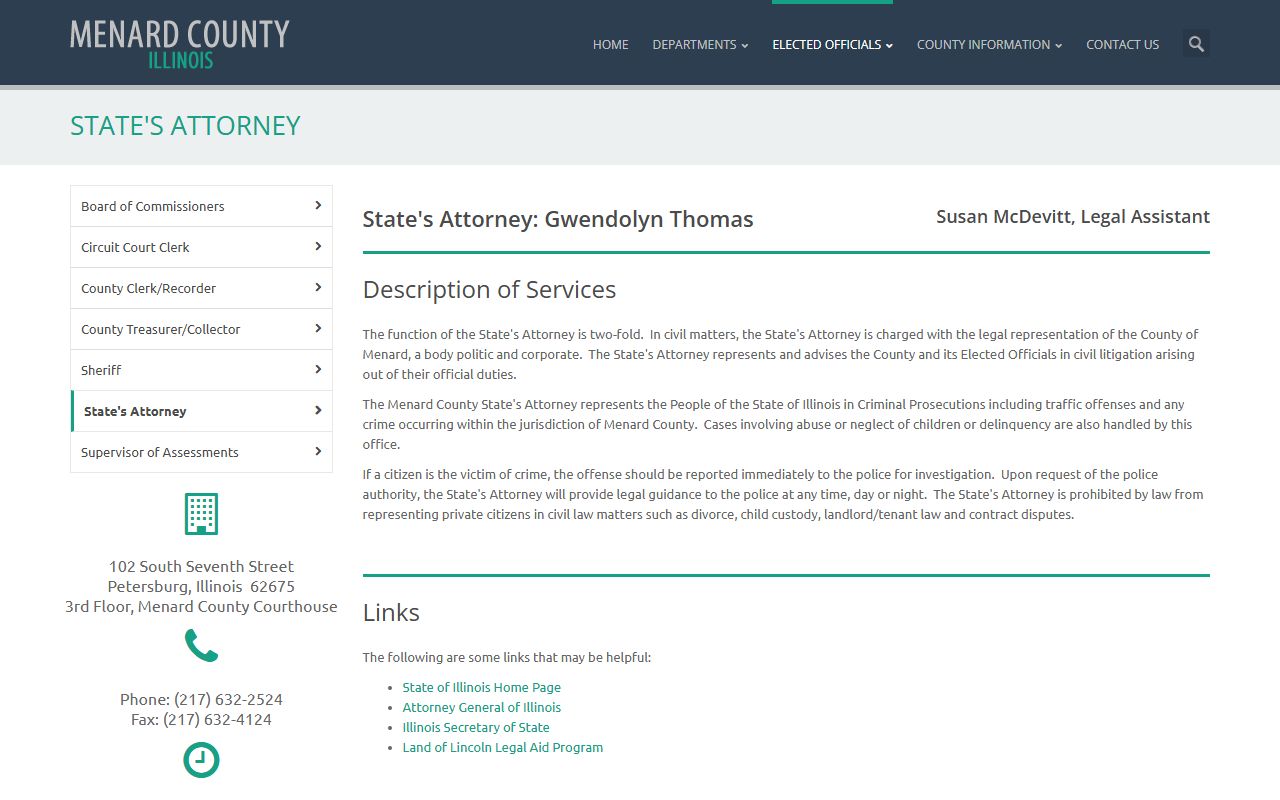
The State's Attorney's office, shown above, decides what charges to file after an arrest, which is the moment a Menard County court record opens.
From a Menard County Arrest to a Court Record
The path from a Menard County arrest to a court record runs in a clear order: Arrest and booking at the jail, then a first appearance, then the State's Attorney files the charging document, and the circuit clerk opens the case. Only at that filing step does a searchable court record exist. Before it, the roster shows custody, but the formal charges have not been entered.
One local detail shapes the handoff. The sheriff provides courthouse security, and court security officers serve as bailiffs who take people sentenced during court into custody and deliver them to the jail. That is the point where a court outcome can send someone back to the Menard jail, which then shows on the roster as a sentenced or awaiting-sentence status. The court record explains the disposition, and the roster reflects the custody that follows.
How to Find Menard County Court Records After an Arrest
Filed criminal cases in Menard County are searched through the Judici court case-search portal linked by the circuit clerk. The clerk files all new court cases, including criminal, civil, family, and juvenile matters, and keeps the case file once charges are filed. Arrest and booking detail stays on the jail roster, but the charges, hearings, and dispositions live in the court record.
- Open the Menard County Judici case search.
- Search by defendant name, or by case number if you have one from a citation, warrant, or court paperwork.
- Open the case and read the charge list filed by the prosecutor.
- Check each charge's statute, level, and current status as the case moves.
The official Menard County Circuit Court Clerk page carries that Judici link and explains the office's records. Computerized records reach back to 1994, older records to 1839 require a physical search, and adoption and juvenile records stay confidential. The clerk can also run a criminal background check from a written, fax, or walk-in request, with no fee for a walk-in. The Menard County Judici case search shown below is the portal the clerk links for those filed cases.
The Judici search shown above is the practical path to the filed charges and case events for a Menard County arrest.
How Charges Get Filed After an Arrest
Booking happens at the jail, and then the charge record begins when the prosecutor files a charging document. Illinois uses three main types, and which one applies depends on the level of the offense. A complaint is common for lower-level matters, an information is used for many felonies, and an indictment comes from a grand jury for serious felonies. All three open the case that becomes the court record.
| Complaint | Information | Indictment | |
|---|---|---|---|
| Filed By | Officer / Prosecutor | Prosecutor | Grand Jury |
| Common For | Misdemeanors | Many felonies | Serious felonies |
| Starts | The case | The case | The case |
Note: a Menard arrest can produce a court case in another county when the hold is for an outside agency, so check the county that actually filed the charge.
Charge Status in a Menard County Court Record
Charges change as a case moves. The prosecutor can amend a count, reduce it, add a count, or drop it, and the booking charge on the jail roster can differ from the charge finally filed. Reading the status terms is the only way to know where a case stands. The table defines the ones that show up most in a court record.
| Status | What It Means |
|---|---|
| Pending | The filed charge is still waiting for court resolution. |
| Amended / Reduced | The prosecutor changed the charge or lowered it as the case moved. |
| Dismissed | A charge or count ended without a conviction on that count. |
| Nolle Prosequi | The prosecutor chose not to pursue the charge, ending that count. |
Other terms appear at the end of a case. A continuance moves a court date later, a disposition is the final outcome, and a sentence is the penalty after a conviction or qualifying plea. If a Menard roster row shows a sentence such as serving a set number of days, the court record is where you confirm the disposition behind it.
Release and Bond After a Menard County Arrest
Illinois changed how release works at first appearance under its pretrial reform, so the old cash-bail model is not the central system anymore. Courts now address release, release conditions, detention hearings, and the denial of pretrial release. 725 ILCS 5/110-2 covers release by citation or notice to appear, and 725 ILCS 5/110-6.1 governs petitions to deny pretrial release. Local language still says "bond," and the Menard roster still shows bond text, so both the everyday term and the current law matter.
| Term | How It Works |
|---|---|
| Release on conditions | The court releases the person with conditions while the case is pending. |
| Citation / notice to appear | Release without custody, with a court date to return. |
| Detention hearing | A hearing where the court decides whether to deny pretrial release. |
| No-release hold | A warrant or detainer can keep someone held even when a dollar figure shows zero. |
To pay a permitted bond or confirm release, call the jail at (217) 632-2273 first, because a hold can block release even when a dollar field appears. Payment runs through the lobby kiosk or JailATM, and money orders go to staff at the window.
Warrants Behind a Menard County Arrest
Menard County does not publish a public online warrant list, and the sheriff's portal warrant module was not active during the source review. Warrant information still surfaces in two ways. After a person is booked, the jail roster can show warrant hold reasons, such as a failure-to-appear warrant with a warrant number issued by the court. Once a court case exists, Judici can show bench-warrant or failure-to-appear activity. To check on a warrant, call the sheriff's office at (217) 632-4458 or the jail at (217) 632-2273, or contact the circuit clerk about a case. Do not rely on unofficial warrant databases, and speak with an attorney or the court before appearing, because an active warrant can lead to arrest.
Older Menard County Court Records
Judici is the fastest route, but it does not hold every historical case. The circuit clerk keeps computerized records back to 1994, and older files reaching to 1839 require a physical search of printed records in the office. For a case the online search will not show, contact the Menard County Circuit Court Clerk at (217) 632-2615, or visit the office at 102 South Seventh Street, 2nd Floor, in the Menard County Courthouse. The clerk can also handle written and fax inquiries. Adoption and juvenile records stay confidential, and fees may apply to some requests, so ask the clerk what a specific record search will cost.
Charges vs. Convictions in Menard County
Being arrested and charged is not the same as being convicted. A charge is an accusation backed by probable cause. A conviction is a finding of guilt after a plea, a trial, or another qualifying disposition. Both can appear in a public court record, which is why reading the disposition matters before drawing any conclusion from an arrest.
| Charge | Conviction | |
|---|---|---|
| Stage | Accusation | Verdict or plea |
| Burden of Proof | Probable cause | Beyond reasonable doubt |
| Public Record | Yes | Yes |
Sealing a Menard County Arrest Record
Illinois lets people clear eligible arrest and court records through sealing or expungement under 20 ILCS 2630/5.2. Sealing hides a record from most public view, while expungement removes it as though it never existed. Eligibility depends on the charge and how the case ended, and the process runs through the court and the circuit clerk, not through the jail roster.
| Sealed | Expunged | |
|---|---|---|
| Visibility | Hidden from public | Destroyed / treated as never existed |
| Law Enforcement | Limited access | Very limited |
| Eligibility | Set by 20 ILCS 2630/5.2 and case outcome | Narrower; often dismissals or acquittals |
Clearing a court record does not automatically remove a booking photo from the sheriff roster. The mugshot side is handled separately on the jail mugshots page.
Background Check Considerations
There is a difference between a casual court-record lookup and a formal background check governed by federal law. The circuit clerk can run a criminal background check on request, but a clerk background result is not the same as a jail booking record. A formal screening for employment or housing must follow the Fair Credit Reporting Act and use a compliant provider.
Important: This site is not a consumer reporting agency under the FCRA, and its content may not be used to screen anyone for credit, employment, housing, or insurance.
Restricted Court Records After an Arrest in Menard County
Not every court record is open. The circuit clerk handles public inquiries except adoption and juvenile records, which are confidential. Sealed and expunged cases may not appear in a public search at all. Illinois open-records exemptions can also withhold information tied to an active investigation, a juvenile, or a privacy or safety concern. If a search comes up empty, the record may be restricted rather than missing, and the clerk can explain the older-file and confidentiality rules.